Learn to Create a Home for Your Next Chapter
joy of nesting
Learn to Create a Home for Your Next Chapter
Your lifestyle has changed. The kids have moved out. Someone is nearing retirement. Maybe you’re downsizing or moving to a newer home in an active community. This is the moment to learn to create a home for your next chapter. You may have inherited a bunch of older furniture, or perhaps you’ve remarried and you both have pieces you’d like to blend into something cohesive and meaningful.
These life transitions can be challenging yes, but they can also be opportunities to do something for yourself, not as a distraction but as a new focus if you will. Something that will ultimately help you feel more grounded in one of your greatest foundations, your home.
What to Keep, Refresh or Repurpose
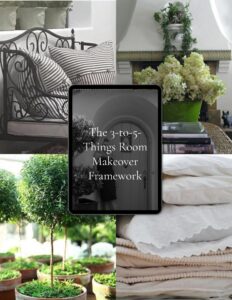
Download the free 3-to-5 Things Home Makeover Framework and find out exactly what to keep, refresh, or replace in your home.
Before You Replace Everything, Ask These Questions
Before you make decisions, it helps to slow down and evaluate what you already have. Inside my home makeover program, I created a simple set of guiding principles for deciding what to keep or replace.
I’m sharing these same principles to help you avoid decision fatigue and consider your key pieces by emotion, function, quality, scale and beauty so your home can evolve intentionally into a new season of life.
The Urge to Toss it All and Start Over
I understand that initial urge to replace everything. In fact, most designers prefer to work that way, and frankly, it’s less work. But if you step back and honestly evaluate what you have, you’ll find that the better opportunity lies in a more thoughtful approach: keep what’s working, refresh what’s good but showing age, and replace only the pieces that will never work, swapping them out for updated items that carry your new style forward.
Future Heirlooms
Some furnishings merit preservation.
A lifetime of use and the stories that come with them make them natural candidates to become the next generation’s heirlooms. Think of the pieces collected with a beloved partner. Or the furniture you’ve inherited. And then there are the bench made pieces, crafted by hand, built to last generations.
These qualities are priceless and are wonderful opportunities to pass down to future generations.
Does It Have Meaning
Some of the sweetest design decisions start with wonderful stories.
One of my favorites is a client who inherited a little farm table and chairs from her mother. A sibling had left the table out in the rain and the finish was ruined but she loved it too much to let it go. She had it refinished, and then I talked her into slipcovers for the chairs, cut to expose the carved crest rail and tied at the top to show it off.
We chose a blue fabric that complemented the wood, then matched the draperies to the slipcovers.
That little farm table is now the centerpiece of her dining room — restored, meaningful, and completely her own.
When you’re deciding whether to keep something, ask yourself: does this piece carry a memory or a story that matters to me? If yes, it deserves a second chance.
Does It Have an Important Origin
Consider the piece’s origin.
A French or Swedish antique, a chair from an old Tuscan farmhouse, a piece from a historic hotel or notable estate, or something tied to a specific region or era like the California Gold Rush, that kind of provenance adds a layer of authenticity that no new piece can replicate.
If you know where something came from, that story is part of its value.
Is It Large or Expensive to Replace
Consider the replacement cost. A large hutch or cabinet of real quality is extraordinarily expensive to replace today – $15,000 to $25,000 or more for a comparable piece. Refinishing that same piece might run you $2,000 to $7,500.
If your cabinet is solid, well-proportioned, and built to last, but the finish has darkened or dated, refinishing is almost always the smarter investment. And refinishing is always a great opportunity to give your home a custom, pulled together look.
Does It Have Quality
If you have pieces by furniture makers like Baker or Hickory Chair, please think twice before tossing or consigning them.
These are benchmark quality, built from solid wood, designed to last generations, and worth every bit of the investment to refinish or reupholster. It genuinely pains me to see them replaced with mass produced alternatives whose finishes can’t be refinished and whose construction most upholsterers won’t even bother to recover.
Keep them, preserve them, and let them be the catalyst for your new design scheme.
Is It Beautiful or Unique
Beauty is obviously in the eye of the beholder, but if something in your home is particularly beautiful to you, use it as your starting point. Working design decisions around things that you find beautiful is an excellent way to begin any home project.
When I walk into a room I’m working on, the first thing I look for is what’s beautiful and what’s not. Can the eyesores be transformed? What pieces would pair well with the beautiful thing and call more attention to it?
I have an antique dining table that I love, but the finish had begun turning orange over time. I had a decorative painter apply a rich, dark wood glaze and it completely transformed it. Building a design scheme around pieces you love is always a good starting point.
Creating a Home That Reflects Your Next Chapter
Your home takes on new importance later in life, especially during life transitions.
Maintenance becomes more of a consideration certainly, but equally important is that you feel grounded, comfortable and surrounded by things that mean something to you.
The good news is you already have more to work with than you realize. It’s simply a matter of knowing what to keep, what to refresh, and what to let go.
That’s exactly what my 3-to-5 Things Home Makeover Framework was designed to help you do. It walks you through the key decisions so you can move forward with clarity and intention.
Before You Replace Everything, Ask These Questions
Before you make decisions, it helps to slow down and evaluate what you already have. Inside my home makeover program, I created a simple set of guiding principles for deciding what to keep or replace.
These principles will help you sort through decision fatigue and consider your key pieces by emotion, function, quality, scale and beauty—so your home can evolve intentionally into a new season of life.
The Urge to Toss it All and Start Over
I understand that initial urge to replace everything. In fact, most designers prefer to work that way, and frankly, it’s less work. But if you step back and honestly evaluate what you have, you’ll find that the better opportunity lies in a more thoughtful approach: keep what’s working, refresh what’s good but showing age, and replace only the pieces that will never work, swapping them out for updated items that carry your new style forward.
Future Heirlooms
Some furnishings merit preservation.
A lifetime of use and the stories that come with them make them natural candidates to become the next generation’s heirlooms. Think of the pieces collected with a beloved partner. Or the furniture you’ve inherited. And then there are the bench made pieces, crafted by hand, built to last generations.
These qualities are priceless and are wonderful opportunities to pass down to future generations.
Does It Have Meaning
Some of the sweetest design decisions start with wonderful stories.
One of my favorites is a client who inherited a little farm table and chairs from her mother. A sibling had left the table out in the rain and the finish was ruined but she loved it too much to let it go. She had it refinished, and then I talked her into slipcovers for the chairs, cut to expose the carved crest rail and tied at the top to show it off.
We chose a blue fabric that complemented the wood, then matched the draperies to the slipcovers.
That little farm table is now the centerpiece of her dining room — restored, meaningful, and completely her own.
When you’re deciding whether to keep something, ask yourself: does this piece carry a memory or a story that matters to me? If yes, it deserves a second chance.
Does It Have an Important Origin
Consider the piece’s origin.
A French or Swedish antique, a chair from an old Tuscan farmhouse, a piece from a historic hotel or notable estate, or something tied to a specific region or era like the California Gold Rush, that kind of provenance adds a layer of authenticity that no new piece can replicate.
If you know where something came from, that story is part of its value.
Is It Large or Expensive to Replace
Consider the replacement cost. A large hutch or cabinet of real quality is extraordinarily expensive to replace today – $15,000 to $25,000 or more for a comparable piece. Refinishing that same piece might run you $2,000 to $7,500.
If your cabinet is solid, well-proportioned, and built to last, but the finish has darkened or dated, refinishing is almost always the smarter investment. And refinishing is always a great opportunity to give your home a custom, pulled together look.
Does It Have Quality
If you have pieces by furniture makers like Baker or Hickory Chair, please think twice before tossing or consigning them.
These are benchmark quality, built from solid wood, designed to last generations, and worth every bit of the investment to refinish or reupholster. It genuinely pains me to see them replaced with mass produced alternatives whose finishes can’t be refinished and whose construction most upholsterers won’t even bother to recover.
Keep them, preserve them, and let them be the catalyst for your new design scheme.
Is It Beautiful or Unique
Beauty is obviously in the eye of the beholder, but if something in your home is particularly beautiful to you, use it as your starting point. Working design decisions around things that you find beautiful is an excellent way to begin any home project.
When I walk into a room I’m working on, the first thing I look for is what’s beautiful and what’s not. Can the eyesores be transformed? What pieces would pair well with the beautiful thing and call more attention to it?
I have an antique dining table that I love, but the finish had begun turning orange over time. I had a decorative painter apply a rich, dark wood glaze and it completely transformed it. Building a design scheme around pieces you love is always a good starting point.
Creating a Home That Reflects Your Next Chapter
Your home takes on new importance later in life, especially during life transitions.
Maintenance becomes more of a consideration certainly, but equally important is that you feel grounded, comfortable and surrounded by things that mean something to you.
Next Steps
The good news is you already have more to work with than you realize. It’s simply a matter of knowing what to keep, what to refresh, and what to let go.
Download the 3-to-5 Things Home Makeover Framework here. It walks you through the key decisions so you can move forward with clarity and intention.
What is Wellness Design? Learn more about the connection between your wellbeing and your home, featured on Deirdre Fitzpatrick’s Dying to Ask Podcast. And if you’d like to dive deeper into this topic, check out my blog post, “Hiring an Interior Designer”.
June 17, 2026
What's Popular
READERS' FAVORITES